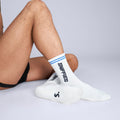


Nobody in a photograph by London-based Oli Raptor is shy. His sitters gleefully spread their cheeks, mostly outdoors, and flash their cocks in photo booths like it’s the most natural thing in the world.

Outsider/s and /Stripped/, his two titles for independent publisher Bona Varda, read like a catalogue of who he’s fucked, photographed, or both. That’s not incidental. At a moment when queer desire has never been more visible, filtered, hashtagged, endlessly scrollable, Oli is doing something almost contrarian. He’s insisting that the people in front of his camera were real, not content but company.
Oli shot Outsider/s, his sold-out photo book, across famed London cruising grounds like Hampstead Heath and Hackney Marshes, with detours to Seattle, Tokyo, and Gran Canaria. The project grew out of a 2009 Craigslist ad seeking life-drawing subjects. What began as a search for bodies to draw became something closer to a search for connection.
What remained is closer to what writer Dominic Johnson, who teaches at Queen Mary University of London and wrote the accompanying essay for Outsider/s, calls cruising’s “sweet spot”, the moment when “many of the organising differences of gay culture appear to melt away: class, age, race, nationality, sexuality, gender, style, beauty, endowment.”

/Stripped/ takes that same instinct and brings it indoors and into an analogue photo booth, trading the anonymity of the bushes for the closer, more exposing company of friends and lovers. That same hunger for connection that sent Oli out cruising in Outsider/s remains‚ even when the setting has changed. But here it’s quieter, more intimate and harder to look away from.
/Stripped/ began small, and with Autofoto London’s support. “It started with two strips I did with a guy I was dating, in a bar in Seattle called Pony,” Oli says. “His half got lost in a house fire last year.” Then Bona Varda’s David McLean pulled out his copy of Warhol’s Photobooth Pictures, and a fling turned into a project.
The subjects run the gamut of London’s queer scene. International Cabaret star Mark T.Cox went first, shot guerilla-style at Hackney Bridge before Autofoto handed over its studio. What was meant to be a couple of days’ shooting turned into two intense nights and roughly 40 people, everyone from a clown to a pup cycling through the velvet curtains.

Muckles (The Muckle Stoater), London’s resident fetish clown, brought a bag of latex and socks so stripey that Oli compared him to the Wicked Witch of the West. Hera, whom Oli had photographed years earlier before transitioning, came back to sit “fully themselves,” as Raptor put it. Artist, perfumer and model, John Foley also makes an appearance and closing out the book is a pup named Zac, who was shot at the Photographer’s Gallery. They’re shot twice, in fact: once collared as the pup, once holding the chain as the master. Mario B, who’d appeared in Outsider/s was meant to be back for this one too, but, unfortunately passed away in January. The book is dedicated to his memory.
Amidst all the ecstasy and nudity, there’s a melancholic edge to the work. And that makes sense: Oli started the book in a relationship and finished it single, breaking up with his boyfriend a week after the last shoot. “It’s got all this love and joy, friends and lovers and strangers,” he says, “but the one person I loved the most wasn’t in it.” /Stripped/ isn’t just a party. It’s also a breakup album, and Oli doesn’t pretend otherwise.
I can’t help but think of Hal Fischer’s seminal Gay Semiotics as a useful foil to Oli’s work, not because /Stripped/ resembles it visually, but because the two works share a method, separated by a very different approach. Fischer’s work is fundamentally structuralist. Fix the signs, hanky codes, stances and glances. These codes that were once only legible to insiders became available to anyone willing to read the book. Oli’s work has a similar instinct, but his photos seem less interested in identifying fixed vocabulary, and more focused on capturing what refuses to hold still—a ‘queer semiotics’, rather than a gay one. I see this work in the same lineage, a record of one moment that will end up shaping whatever comes next.
That cultural churn is at play in Oli’s next project as well, a zine called Flip Flop, made jointly with exiled Russian artist Slava Mogutin. There, he trades his camera for collages, Polaroids, clippings from vintage porn, and a return to drawing, each artist working in from his own side of the page until the two halves meet in the middle. “It’s a loop,” Oli says of the drive behind it, “each generation absorbing what came before and feeding it forward again.”